Introduction
“We are too small for ISO.” “It will cost a fortune.” “Maybe next year.”
We hear these lines from small business owners every week. Most of them are based on myths, not facts. Meanwhile, competitors who hold an ISO certificate are winning the tenders, vendor registrations and client trust that uncertified businesses miss out on.
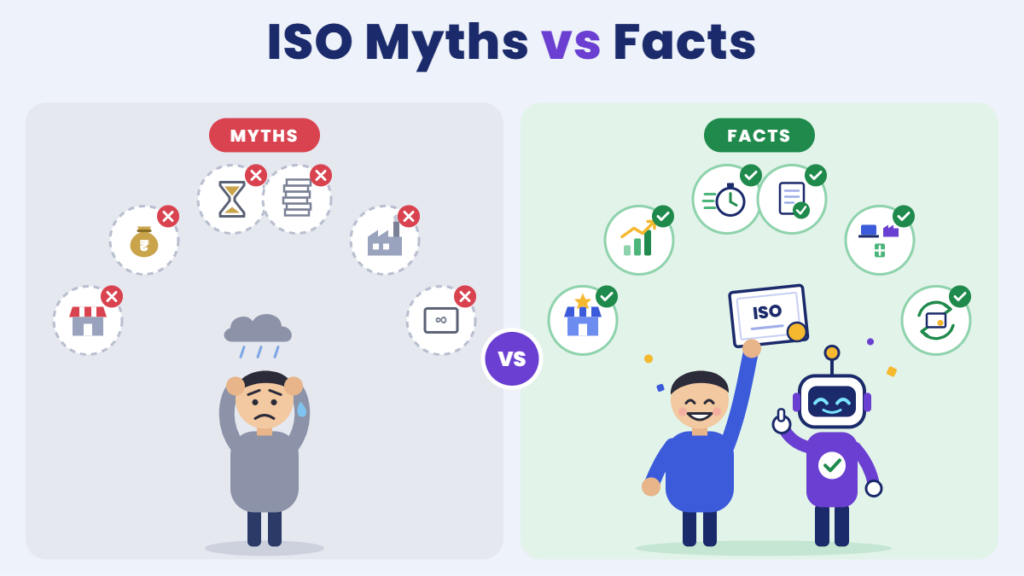
In this blog, we bust six of the most common ISO certification myths, so you can decide based on facts rather than assumptions.
“We’re Too Small for ISO”: Size Has Nothing to Do With It
The truth: ISO standards are designed to apply to organisations of every size, from a five-person workshop to a multinational. There is no minimum turnover or employee count.
In fact, small businesses often benefit the most. A large company already has a known brand. A small business does not, and an ISO certificate gives buyers an instant, recognised reason to trust you. It helps you stand on the same footing as bigger competitors when you apply for vendor lists and tenders.
“It Will Cost a Fortune”: Count What You’re Missing Instead
The truth: Certification cost depends mainly on the size of your organisation, the number of locations and the standard you choose. A small business with one site and a focused scope pays far less than a large multi-location company.
It also helps to look at the cost against what you gain. A single contract or vendor registration that requires ISO can easily cover the investment. Many government tenders and large buyers simply will not consider uncertified suppliers, so the real cost is often the business you lose without it.
“It Takes Forever”: Think Weeks, Not Years
The truth: For a small business with a clear scope and the right guidance, certification can be completed in a matter of weeks, not years. Delays usually happen when businesses try to figure out the requirements on their own.
Working with an experienced consultant keeps the process on track. You know exactly what is needed at each stage, so there is no guesswork and no time lost.
“We’re Already Drowning in Paperwork”: Let Someone Else Hold the Pen
The truth: Documentation is part of ISO certification, but you do not have to build it alone. A good consultant prepares the required documents for you and tailors them to how your business already operates.
Your team’s role is mainly to provide information and be available during the audit. You keep running your business while the documentation is handled for you.
“We’re Not a Factory”: ISO Fits Every Industry
The truth: ISO certification is relevant to almost every industry. IT companies, consultancies, traders, hospitals, schools, logistics firms, hotels and food businesses all hold ISO certificates.
There are standards for quality (ISO 9001), information security (ISO 27001), food safety (ISO 22000), occupational health and safety (ISO 45001) and more. Whatever your industry, there is very likely a standard your clients recognise and value.
“Certified Once, Sorted Forever”: Not Quite
The truth: An ISO certificate is typically valid for three years, with periodic surveillance audits during that period to keep it active. At the end of the cycle, the certificate needs to be renewed.
This is not a burden when you plan for it. Keeping your certificate valid protects your vendor registrations and contracts, since many buyers check certificate validity before renewing orders. An expired certificate can quietly cost you business you have already won.
How Progressive Global Helps Small Businesses Get Certified
Since 2009, Progressive Global has helped businesses of all sizes get ISO certified without disrupting their daily work. Here is what working with us looks like:
- Free consultation to identify the right standard for your business and your clients
- Complete documentation support, prepared by our team and tailored to your business
- Clear timelines built around your business needs
- Renewal support to keep your certificate valid year after year
We work with businesses across India and internationally for ISO 9001, ISO 14001, ISO 45001, ISO 27001, ISO 22000, ISO 20000 and ISO 42001.
Frequently Asked Questions
Can a small business or startup get ISO certified?
Yes. ISO standards apply to organisations of any size, and there is no minimum number of employees or turnover.
Which ISO certification should a small business start with?
ISO 9001:2015 is the most widely recognised standard and is relevant to every industry, which makes it the natural first certificate for most businesses.
How long is an ISO certificate valid?
An ISO certificate is typically valid for three years, with periodic surveillance audits to keep it active.
Do I need to hire extra staff for ISO certification?
No. With the right consultant handling the documentation, your existing team only needs to share information and be available during the audit.
Conclusion
ISO certification is not reserved for large corporations with big budgets. It is a practical, achievable step for small businesses that want to win bigger clients, qualify for tenders and build trust in new markets.
Don’t let myths hold your business back.
Contact Progressive Global today for a free consultation, and let us help you get ISO certified quickly and confidently.
📧 iso@progressiveglobal.co.in | 🌐 www.progressiveglobal.co.in