


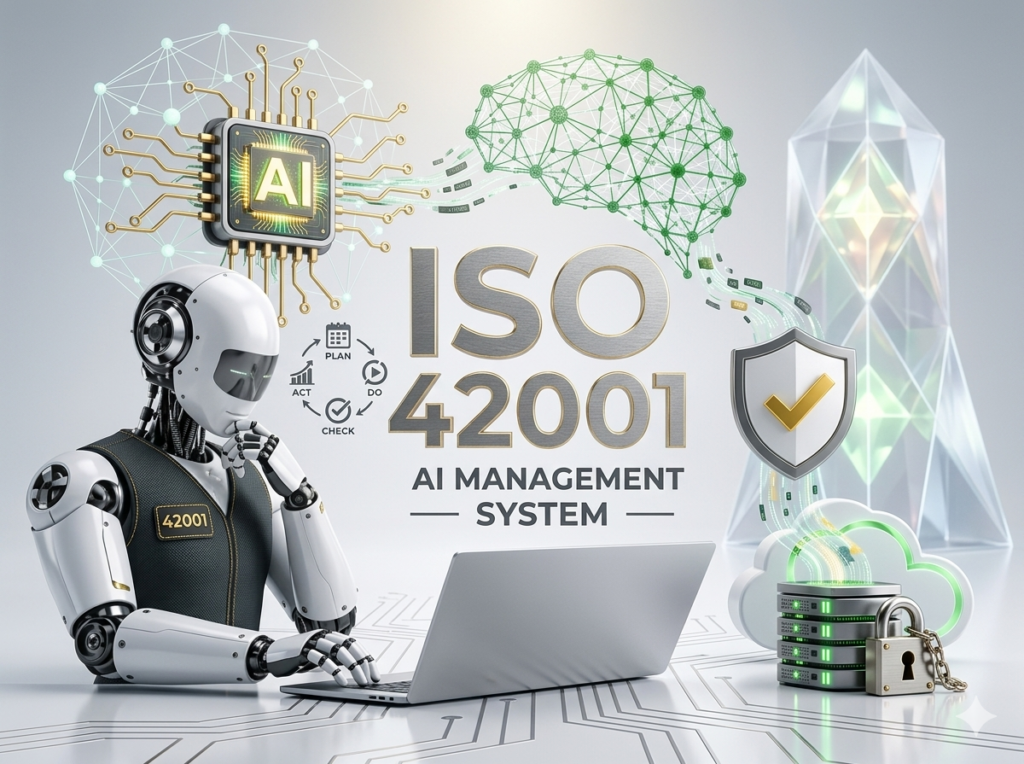
ISO 42001:2023 The World’s First AI Management System Certification Standard
INTRODUCTION
Artificial intelligence is transforming industries worldwide, but its rapid growth has also introduced ethical, privacy, and security concerns. In response, the International Organization for Standardization (ISO) and the International Electrotechnical Commission (IEC) published ISO/IEC 42001:2023 – the world’s first certifiable standard for Artificial Intelligence Management Systems (AIMS).
Released in December 2023, ISO 42001:2023 remains the current and newest version. This standard provides organizations with a comprehensive framework for the responsible development, implementation, and utilization of AI-based solutions.
WHAT IS ISO 42001:2023
ISO/IEC 42001 specifies requirements for establishing, implementing, maintaining, and continually improving an Artificial Intelligence Management System (AIMS) within organizations.
The standard is designed for entities that:
- Provide AI-based products or services (AI providers)
- Develop AI systems (AI producers)
- Use AI products or services (AI users)
Unlike one-time assessments, ISO 42001 establishes a systematic, repeatable process for AI governance that evolves alongside regulatory requirements.
KEY REQUIREMENTS OF ISO 42001:2023
| Clause | Focus Area | Key Requirements |
|---|---|---|
| Clause 4 | Context of Organization | Determine AI objectives, identify stakeholders, define AIMS scope |
| Clause 5 | Leadership | Top management commitment, AI policy establishment, roles & responsibilities |
| Clause 6 | Planning | AI risk assessment, system impact assessment, objectives planning |
| Clause 7 | Support | Resources, competence training, awareness, communication, documentation |
| Clause 8 | Operation | Operational control, risk assessment/treatment, impact assessments |
| Clause 9 | Performance Evaluation | Internal audits, management reviews, metrics monitoring |
| Clause 10 | Improvement | Continual improvement, corrective actions for nonconformities |
UNIQUE ISO 42001 REQUIREMENTS
Two assessments are unique to ISO 42001:
- AI Risk Assessment – Analyzes and evaluates AI-specific risks across the lifecycle
- AI System Impact Assessment – Determines potential consequences of AI deployment on individuals, groups, and society
ANNEX A CONTROLS THE CORE FRAMEWORK
Annex A defines all reference control objectives in ISO 42001. Organizations can select controls relevant to their needs and even create custom controls.
Key Control Categories:
| Category | Controls | Purpose |
|---|---|---|
| Policies & Governance | A.2 (AI Policy), A.3 (Internal Organization), A.8 (Information for Stakeholders) | Establish leadership direction, accountability lines, transparency |
| Data Controls | A.7 (Data for AI Systems) | Data quality, provenance, acquisition, preparation to prevent bias |
| AI Lifecycle Controls | A.4 (Resources), A.6 (AI System Life Cycle), A.9 (Use of AI Systems) | Document resources, responsible design/development, monitoring |
| Impact Assessment | A.5 (Assessing Impacts) | Evaluate effects on individuals and society throughout lifecycle |
| Third-Party Relationships | A.10 | Allocate responsibilities with suppliers and customers |
BENEFITS OF ISO 42001 CERTIFICATION
- TRUST AND CREDIBILITY
Demonstrates ethical AI practices to clients, partners, and regulators.
Builds confidence particularly in finance, healthcare, and technology sectors.
- RISK MITIGATION
Proactively manage AI risks (data breaches, bias, system failures).
Controls across entire AI lifecycle from development to deployment.
- COMPLIANCE WITH FUTURE REGULATIONS
Aligns with EU AI Act demands: risk management, data governance, documentation, monitoring, security, and safety.
Positions organizations to comply with upcoming AI regulations.
- COMPETITIVE ADVANTAGE
Mark of distinction in a crowded AI innovation landscape.
Signals prioritization of innovation with the highest ethical standards.
- OPERATIONAL EXCELLENCE
Structured approach to AI integration.
Streamlines processes and identifies vulnerabilities earlier.
REAL-WORLD SUCCESS: SYNTHESIA CASE STUDY
London-based Synthesia (AI video platform used by 65,000 clients including 70% of Fortune 100) became the first AI video generation company to achieve ISO 42001 certification.
Results:
- Validated stringent security practices with robust AI governance.
- Drew media coverage and significant customer interest.
- Showcased meeting the highest standards for security and compliance.
GETTING STARTED WITH ISO 42001
Next Steps for Your Organization:
- Obtain and study ISO/IEC 42001:2023 standard.
- Initiate internal conversations about the certification audit process.
- Allocate necessary resources for implementation.
- Engage an accredited compliance partner for readiness assessment.
- Download an ISO 42001 checklist to verify readiness.
CONCLUSION
ISO/IEC 42001:2023 represents a significant milestone in AI governance – the world’s first standard for Artificial Intelligence Management Systems.
By adopting this standard, organizations:
- Proactively manage AI risks rather than responding to enforcement.
- Build infrastructure for AI security before heavy regulatory requirements emerge.
- Demonstrate commitment to responsible and ethical AI use.
- Gain competitive differentiation in the AI innovation landscape.
As AI continues evolving, embracing ISO 42001 positions businesses as leaders, fostering trust and ensuring the long-term success of AI initiatives.
Ready to start your ISO 42001 journey? Contact Progressive Global for expert guidance on AI management system certification and compliance implementation.
“`