

ISO 20000 vs ISO 27001: Understanding IT Service Management vs Information Security
If your business runs on IT — whether you’re a software company, an IT-enabled services provider, or a manufacturer with a growing digital backbone — you’ve probably come across both ISO 20000 and ISO 27001. They sound similar, they often get requested in the same client tenders, and many businesses assume they’re interchangeable. They aren’t. Understanding the difference isn’t just an academic exercise. Choosing the right certification (or the right order to pursue both) can save you months of wasted effort and directly affect your ability to win contracts, especially with international clients.What Is ISO 20000?
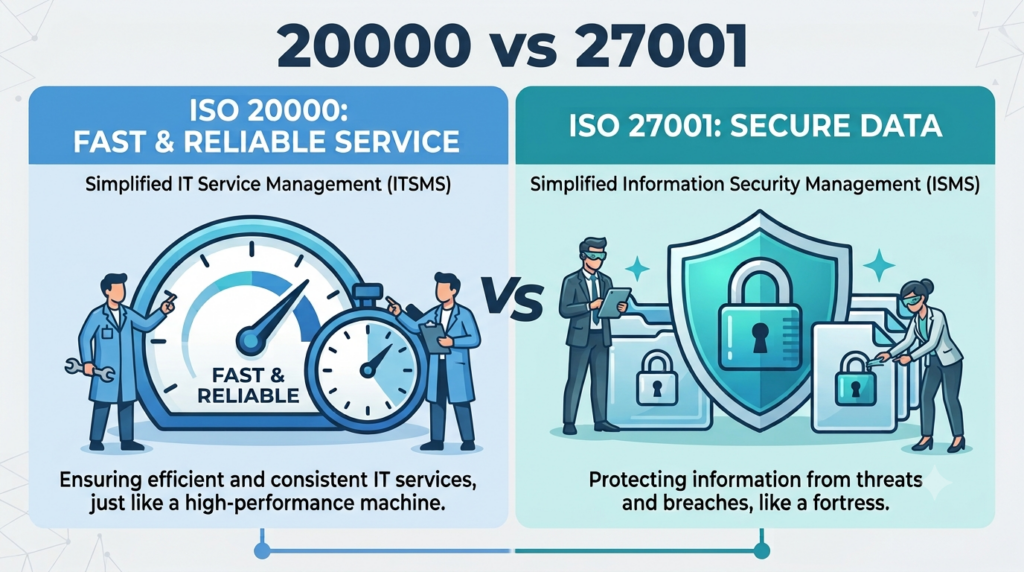
ISO 20000 is the international standard for IT Service Management (ITSM). It focuses on how your organization delivers, manages, and continually improves IT services to internal or external customers. In practice, ISO 20000 certification demonstrates that you have a structured process for handling incidents, service requests, and changes; clear service level agreements (SLAs) and the ability to meet them consistently; a framework for capacity planning, availability management, and service continuity; and a culture of continual service improvement, not just reactive firefighting. Who typically needs it: IT service providers, managed service companies (MSPs), software support teams, and IT departments that serve external clients under contract.What Is ISO 27001?
ISO 27001 is the international standard for Information Security Management Systems (ISMS). It focuses on protecting the confidentiality, integrity, and availability of information — whether that’s client data, financial records, intellectual property, or internal systems. ISO 27001 certification demonstrates that you have a risk-based approach to identifying and managing information security threats; controls covering access management, encryption, physical security, and third-party risk; incident response and business continuity planning for security breaches; and ongoing risk assessments and internal audits. Who typically needs it: IT companies, SaaS providers, BPOs, fintech, healthcare-adjacent businesses, and any organization handling sensitive client or customer data — especially those working with UK, US, UAE, or EU clients where data protection expectations are high.The Core Difference, in One Line
ISO 20000 asks: “Are we delivering IT services reliably and efficiently?” ISO 27001 asks: “Are we protecting the information we handle?” One is about service quality and delivery. The other is about risk and protection. A company can have excellent service delivery (ISO 20000) while still having weak security controls, and vice versa — which is why many organizations, especially IT service providers, eventually pursue both.Quick Comparison
| Aspect | ISO 20000 | ISO 27001 |
|---|---|---|
| Focus | IT service management | Information security management |
| Primary concern | Service quality, SLAs, delivery | Data protection, risk, confidentiality |
| Best fit for | MSPs, IT support, software service teams | IT/ITES, SaaS, BPO, fintech, any data-heavy business |
| Client expectation | “Can you deliver consistently?” | “Can you keep our data safe?” |
| Common trigger | Client SLAs, outsourcing contracts | Client audits, data protection clauses, tenders |